Automatic
Deterministic re-resolution
Structure, templates, OCR, and geometry try to re-find the recorded target. No model is required. A changed anchor is saved as an auditable bundle diff.
Demonstrate a repeated task once. OpenAdapt compiles it into a local program that replays at $0 per healthy run across browser, Windows, macOS, RDP, and Citrix. When the screen changes, it re-checks its evidence, repairs with AI when it can, and halts for a person instead of guessing. See how it runs across every interface.
Purpose-built for repeated, high-stakes GUI work with no clean API, where a wrong action is costly and the result should be verified, not assumed.
Hosted runs in minutes · or run it entirely on your own machine · zero per-run model cost · deterministic replay you can audit
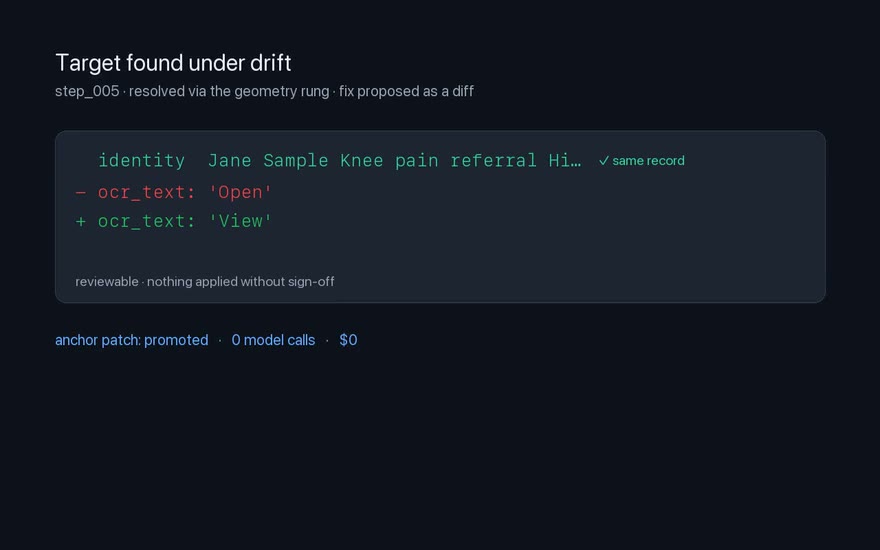
When the interface drifts, OpenAdapt re-resolves from retained evidence. It doesn’t guess.
UI drift → re-resolved via the geometry rung · governed repair saved · 0 model calls
Real capture · reviewable diff · nothing is applied without sign-off
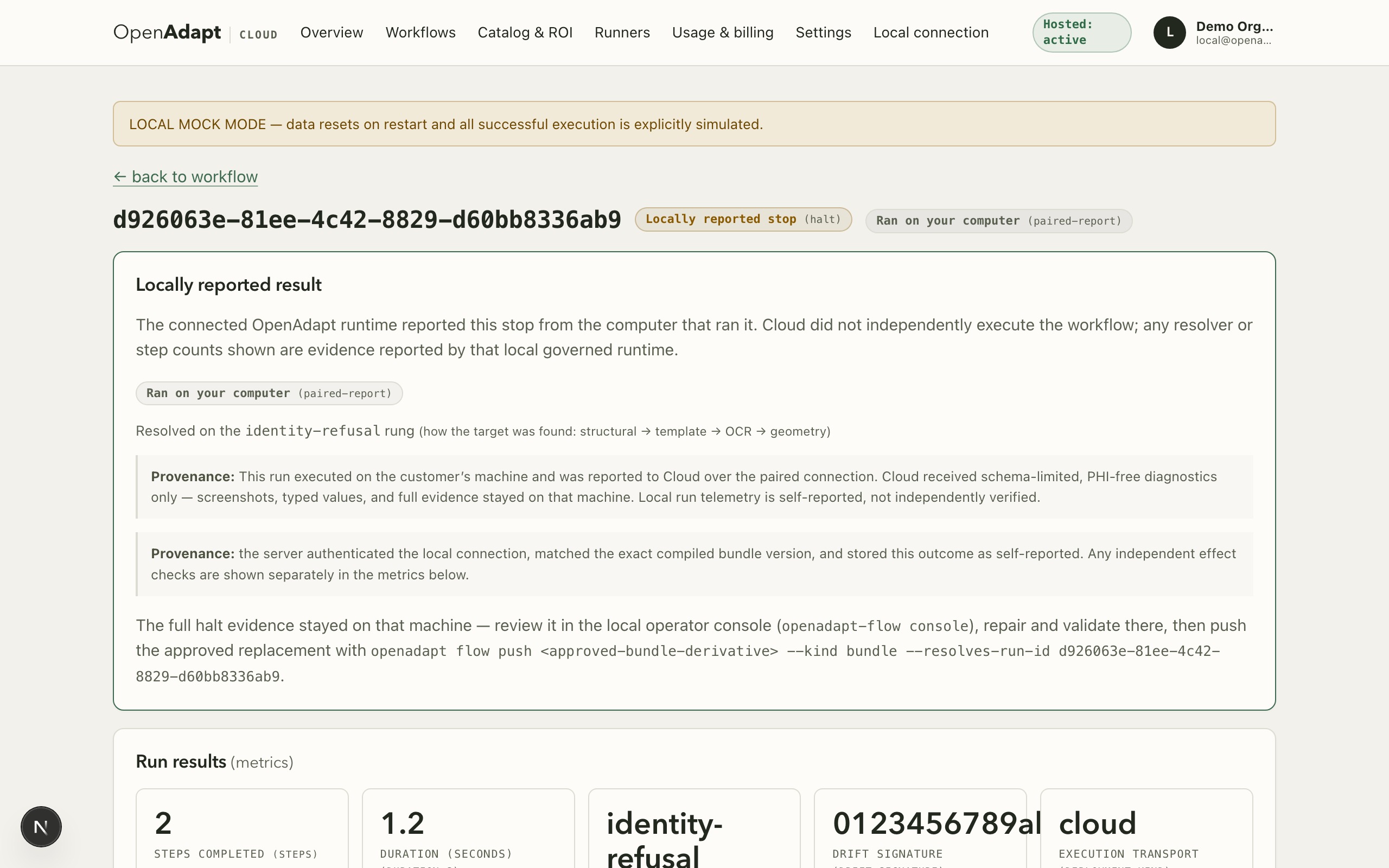
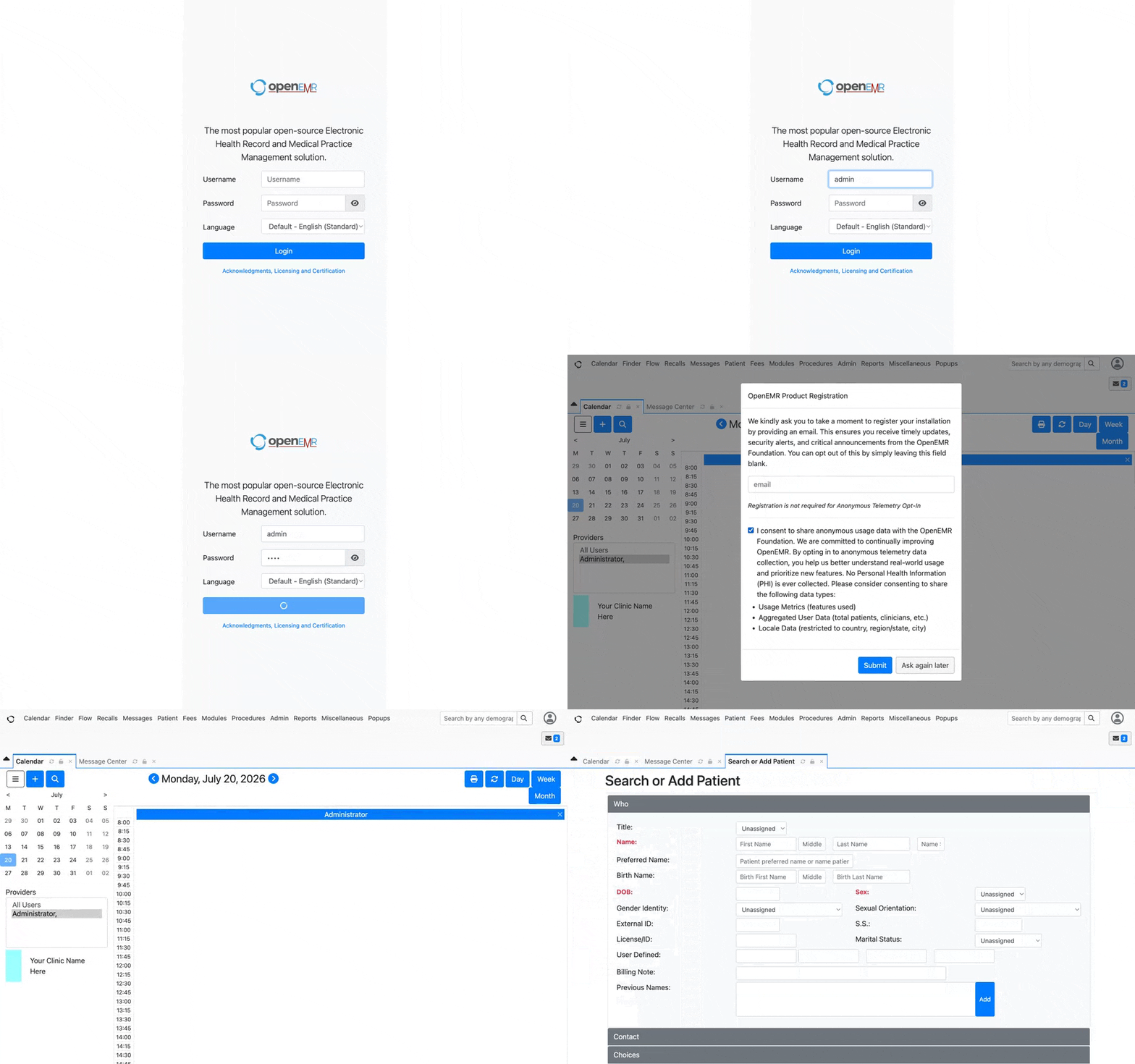
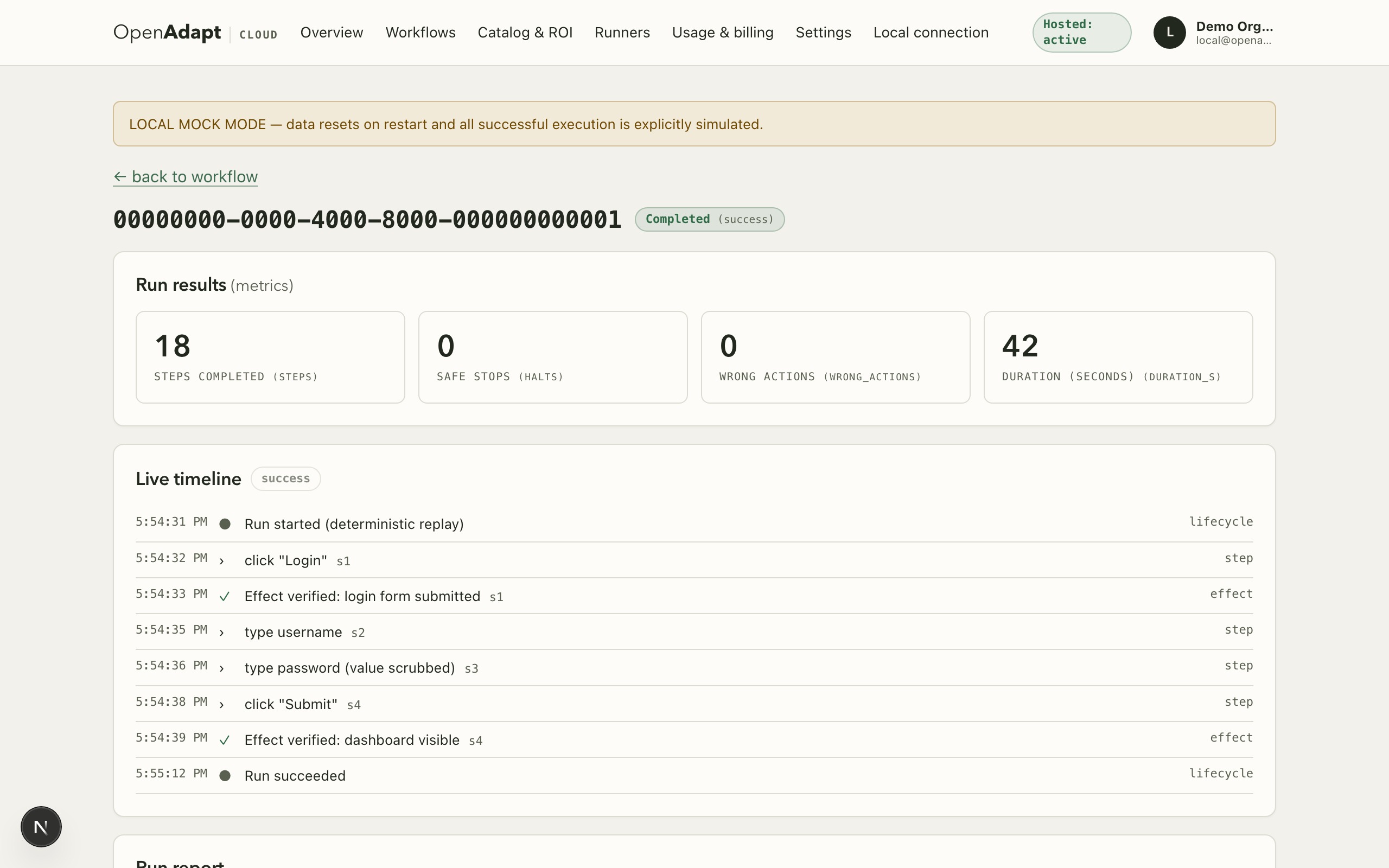 Every run is inspectable in OpenAdapt Cloud.Run history, per-step evidence, and verified effects in the shipping hosted product: app.openadapt.ai
How it works
Three steps, one governed loop. Healthy replay is deterministic; model spend is reserved for compilation or repair.
Demonstrate one bounded, repeated task. OpenAdapt compiles the trace into a reviewable, parameterized program. Not a prompt a model rereads each run.
Healthy runs execute the compiled steps locally with zero model calls. Repeat runs are fast and cost nothing per run.
When the interface drifts, deterministic evidence re-finds the target, an optional model proposes a governed repair, or verification halts and keeps a run report.
Real reference workflow
Synthetic local data, real Frappe Lending interactions, and an oracle outside the replay path.
Reference workflow
Each reference is a bounded, synthetic fixture with its own honest evidence and caveats.
Complete one bounded, synthetic instance while OpenAdapt captures browser evidence and input events.
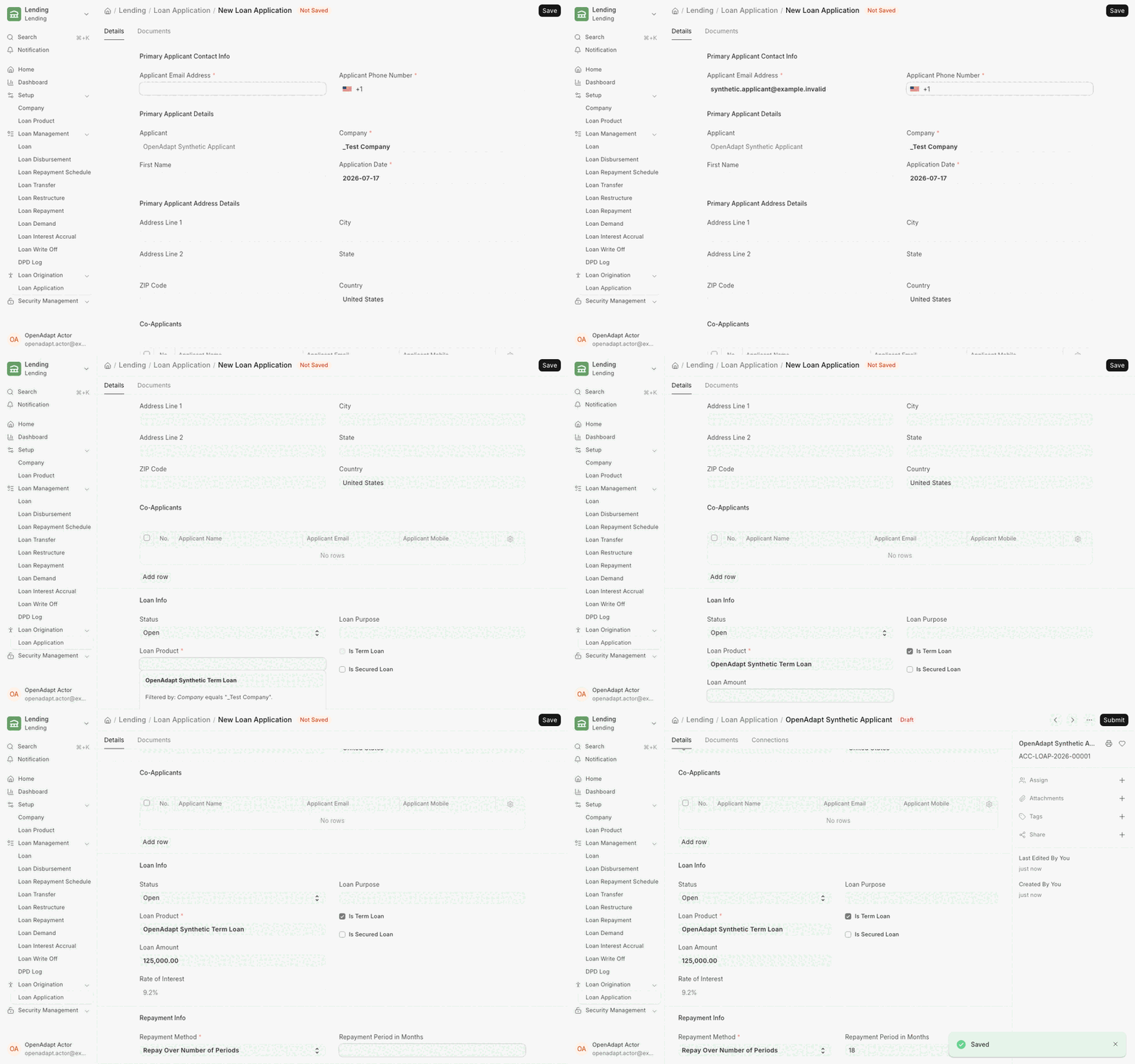
Turn the demonstration into a parameterized, inspectable workflow with a declared business effect.
Execute the compiled steps locally, with no model reinterpreting the task.
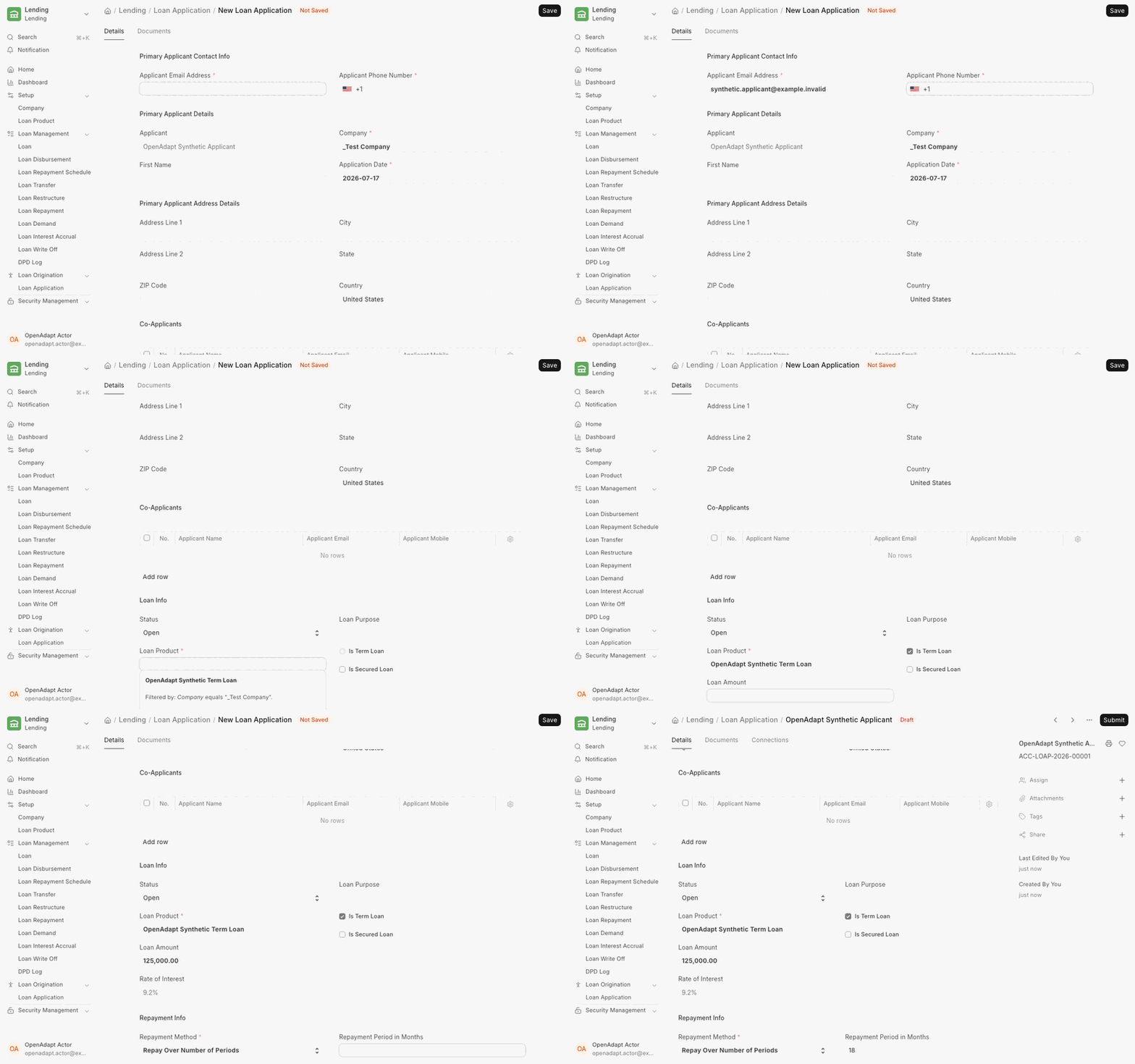
Check the saved record through a separately authenticated read-only session and a direct database delta audit.
Frappe Lending v16.2.0, Frappe v16.27.0, and ERPNext v16.27.0 were pinned in a local fixture with fictional values. The six compiled trials cover one task on one environment under baseline and cosmetic-drift conditions. OpenAdapt is unaffiliated with Frappe Technologies Pvt. Ltd.; Frappe is its registered trademark.
Inspect evidence manifestMore reference workflows
Each reference is a bounded, synthetic fixture with its own honest evidence and caveats. Select one to preview it above.
Want the full method and evidence? Read the technical paper.
OpenAdapt Cloud
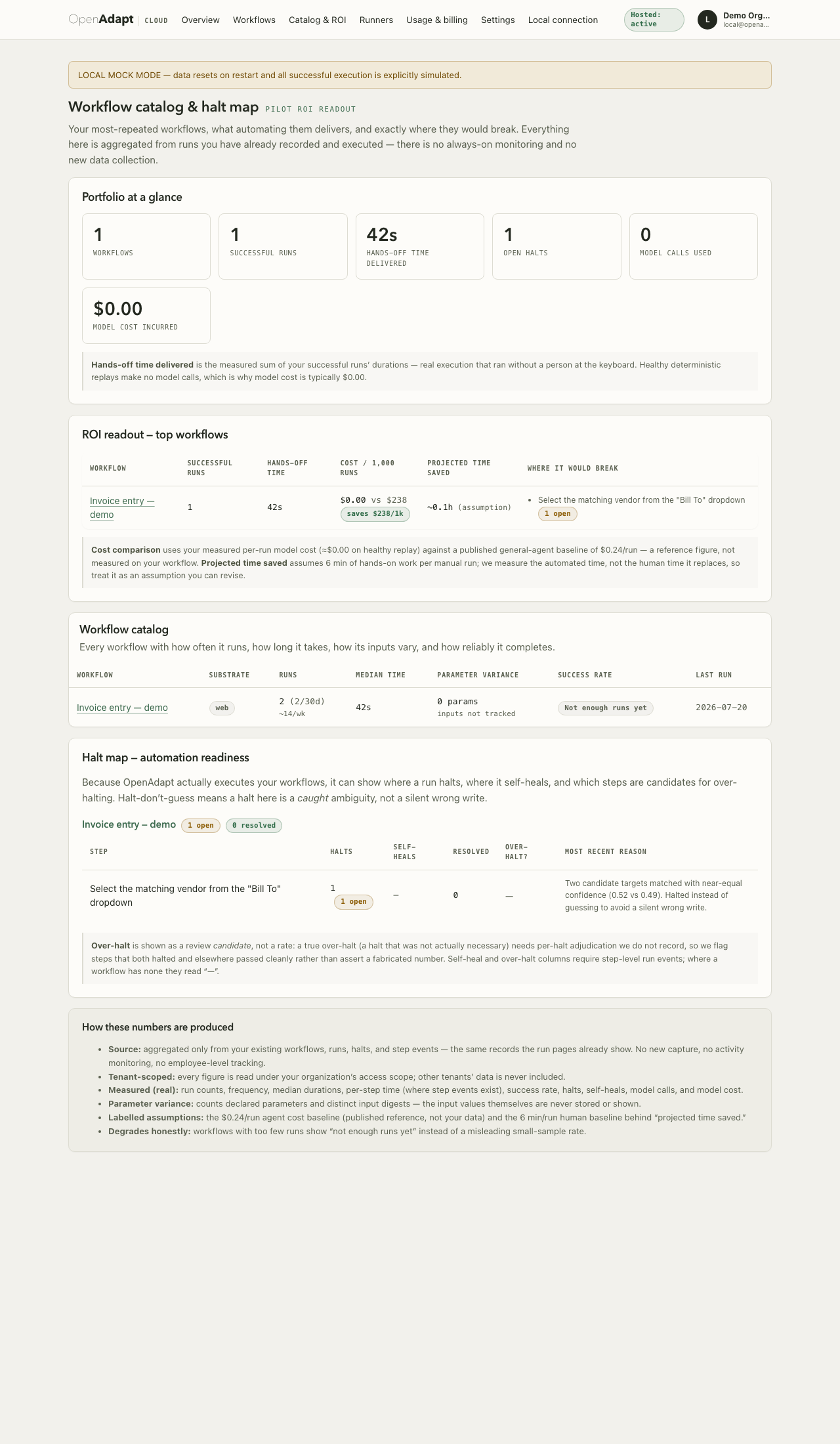
This is the hosted product running today at app.openadapt.ai. Workflows, runs, evidence, and reports stay connected in one reviewable dashboard.
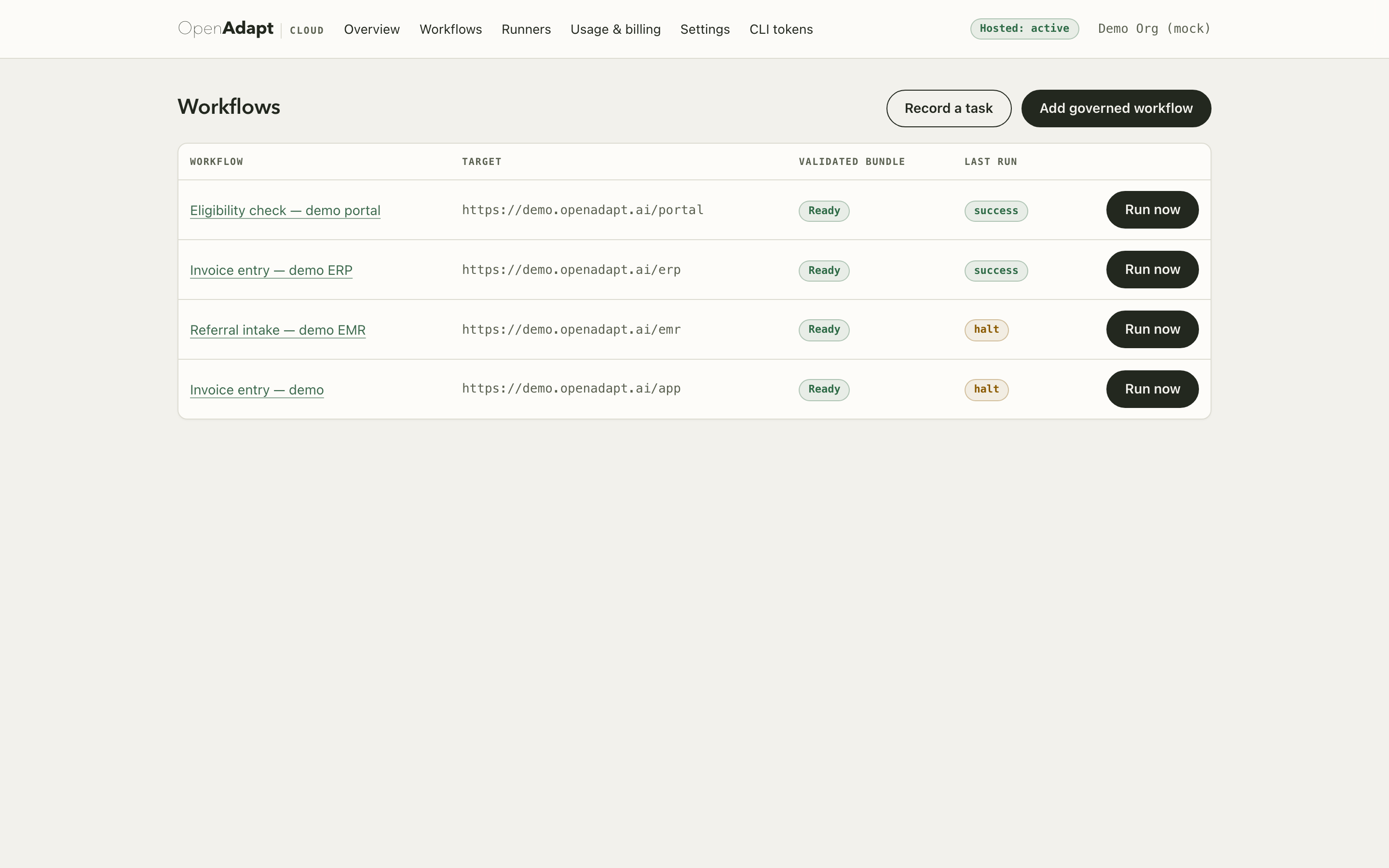
From trace to program
A single demonstration can become a governed loop that runs once per record in a worklist: bounded, identity-gated, and effect-verified per record, halting on ambiguity instead of guessing. One recorded path becomes governed execution over a queue.
openadapt-flow for-each my-bundle --records worklist.csv --out queue-bundleCompiled-program visualizer
A recording under-specifies intent. The compiler turns it into a program you can read before it runs: each step, the resolution ladder, where an identity gate is armed, which writes carry an effect check, and every point the run can halt. Render it from the CLI as a self-contained page or Mermaid, or open the same graph in Cloud.
openadapt-flow visualize my-bundle --format html -o graph.html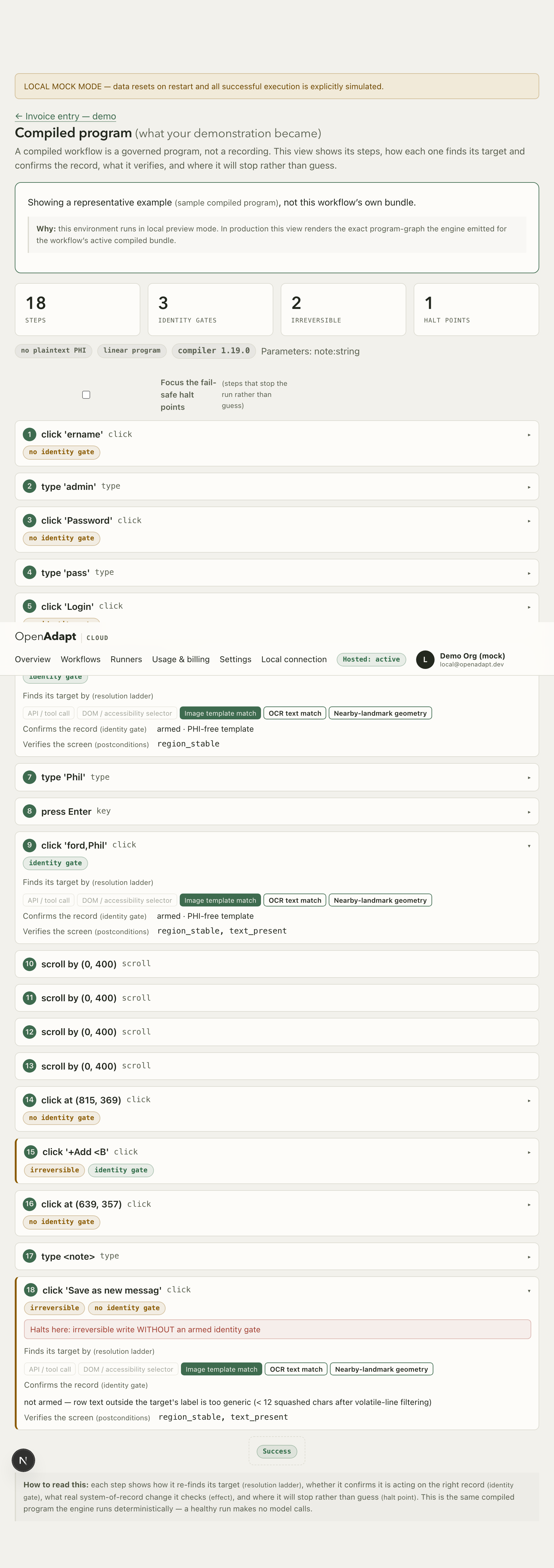
Workflow catalog & halt map
The catalog is a read-only readout across every compiled workflow: what each one automates, how its trials went, and the return it stands to make. The step-level halt map shows where runs stop and why, so you fix the demonstration or policy at the exact step.
UI drift
OpenAdapt is not an unconstrained agent. Drift ends in one of four explicit outcomes, each visible in the run report.
Automatic
Structure, templates, OCR, and geometry try to re-find the recorded target. No model is required. A changed anchor is saved as an auditable bundle diff.
Optional
If deterministic evidence is insufficient and a model is configured, it can propose a target or confirm limited visual state. The model can be wrong, so identity, policy, and postcondition gates still decide whether execution continues.
Operator path
A halt produces evidence for an operator. The CLI can teach a correction, and durable mode can checkpoint verified progress for authenticated approval and resume.
Unsupported drift
If no configured path can establish the target or expected result, the workflow stops. OpenAdapt does not claim general adaptation to arbitrary application changes.
Availability and refusal depend on retained evidence and configuration. Identity checks cover armed steps only; system-of-record verification requires declared effects and a configured verifier. Read the measured limits.
From demonstration to operation
A demonstration becomes an inspectable workflow that runs the same from local development through governed operation.
Demonstrate a bounded, repeated task, plus the evidence OpenAdapt needs to identify targets and verify outcomes.
Turn the demonstration into an inspectable program with parameters, target evidence, postconditions, and an explicit OpenAdapt certification policy.
The fail-closed run gate rechecks the exact bundle and selected policy. Healthy replay makes no model calls and produces structured evidence.
Re-resolve from retained evidence, propose a reviewable repair when needed, and stop when configured verification fails.
One execution model across your stack
From modern browser apps to legacy Windows and remote desktops, workflows stay inspectable, policy-bound, and governed by explicit verification.
Compile DOM, accessibility, visual, and interaction evidence into deterministic browser workflows.
Use structured UI Automation with retained visual evidence to operate legacy desktop applications.
Carry the same policy, verification, repair, and audit model into remote application environments.
Every interface, first-class
Every surface below runs the same governed loop. Each label is read from one machine-readable status manifest, so the website, docs, launcher, and packages stay in lockstep.
Record, compile, and replay browser workflows end to end. Healthy runs make no model calls, and identity, effect, and policy coverage are enforced per bundle before anything executes.
Operate native Windows, macOS, and RDP applications under the same governed loop: structured UI Automation and accessibility evidence, effect verification against an independent oracle, and fail-closed halting when verification does not pass.
Run the governed loop across Citrix and VDI environments with a pixel-and-evidence safety floor. Identity, effect, and policy checks and halt-on-uncertainty carry into remote application delivery.
The managed control plane runs your approved workflows across every substrate with run history, reporting, usage, and governed updates, backed by live billing. Runtime data handling and customer-controlled boundaries are configured per deployment.
Current components: launcher openadapt 1.7.1 · openadapt-flow 1.19.0 · desktop 0.6.2
Choose the execution boundary
Build, inspect, and run qualified workflows on your own infrastructure with the MIT-licensed engine.
View the engineOperate approved workflows across every substrate through the managed control plane with run history, reports, usage, and governed updates.
See hosted optionsKeep runtime data inside a qualified customer boundary when the workflow involves regulated data, private systems, or deployment-specific effect checks.
Review the security boundaryEvery production workflow is qualified against its target application and environment. Technical teams can review the qualification evidence, engine limits and hosted architecture.
Ways to start
Run the MIT-licensed engine yourself for free. Subscribe to OpenAdapt Cloud, the managed control plane that runs approved workflows across every substrate. Or start a scoped paid pilot for regulated data and customer-controlled deployments.
Open Source
For builders and self-hosters running it on their own machines.
pip install openadapt
OpenAdapt Cloud
The managed control plane for governed execution across every substrate: browser, Windows, macOS, RDP, and Citrix. Approved workflows run in the managed runner with run history, reporting, and governed updates. Onboarding is assisted: we qualify the first workflow with you.
By subscribing, you agree to the Terms of Service and acknowledge the Privacy Notice.
Scoped pilot
Priced after qualification
Bring regulated data and customer-controlled deployments under the same governed loop. We qualify the artifact policy, effect oracle, and operating model inside your boundary, then scope and price the pilot before production use.
OpenAdapt Cloud subscriptions open only after the live checkout and account-return path pass launch qualification. Regulated deployment and service terms are scoped separately.
The right fit
OpenAdapt is deliberately narrow: repeated, high-stakes GUI work that has no real API and can be checked against an independent source of truth.
When work fits that shape, OpenAdapt runs it across every interface it touches under one governed loop: browser, Windows, macOS, RDP, and Citrix. See how it compares with RPA, computer-use agents, and browser recorders on the comparison page.
Workflow qualification
Tell us the substrate, repetition, consequence of error, data boundary, and current verification path. We'll tell you whether it fits managed cloud execution or a customer-controlled deployment, and how we'd qualify it.
Open source
pip install openadapt is the stable end-user entry point. The openadapt-flow engine records a workflow, compiles it into a reviewable program, and replays it locally with no model calls on a healthy run.
One command installs the OpenAdapt launcher and governed workflow compiler. The same CLI records, compiles, and replays across browser, Windows, macOS, RDP, and Citrix under one governed loop. No account or hosted service is required.
$pip install openadapt
Try the whole loop right now against the bundled demo app, which runs in the browser: record, compile, inspect, certify, replay, and induce known test drift. No account or cloud service. Once it is installed, your workflow data stays on your machine. One heads-up on first run: the first demo-record or replay downloads a bundled Chromium (~150 MB) once, so that step takes a few minutes, and on Linux you may need playwright install-deps first.
pip install openadaptInstall OpenAdaptopenadapt flow demo-record --out recRecord yourself doing the taskopenadapt flow compile rec --out bundle --name my-taskTurn the recording into a workflowopenadapt flow lint bundleInspect identity, assertion, and risk coverage gapsopenadapt flow certify bundle --policy clinical-writeThe clinical gate refuses this demo bundle and exits non-zero — on purpose. Safeguards refuse instead of guessing. Re-run with --policy permissive to see a clean pass.openadapt flow replay bundleReplay it locally, with zero AI callsopenadapt flow replay bundle --drift themeExercise deterministic re-resolution on bundled test driftpip uninstall openadaptRemove the launcher when you are finishedEvery replay writes a step-by-step run report: what ran, what it saw, what re-resolved, and what halted. Compiler/runtime source and measured limits are in the openadapt-flow engine. Evaluating a regulated workflow? Evaluate a workflow.
Adoption
16.0k installs a month across the OpenAdapt packages · top package openadapt-flow
Cumulative downloads over time, live from pypistats.org.
Product updates and hosted launch information. This does not create an account or promise access.